2 September 2026
LLMs & Phoenix Cart: How to Prepare Your Store for AI-Powered Search
Discover how LLMs and AI-powered search are changing ecommerce, and how to prepare your Phoenix Cart store with clearer content, better structure and AI-friendly information.
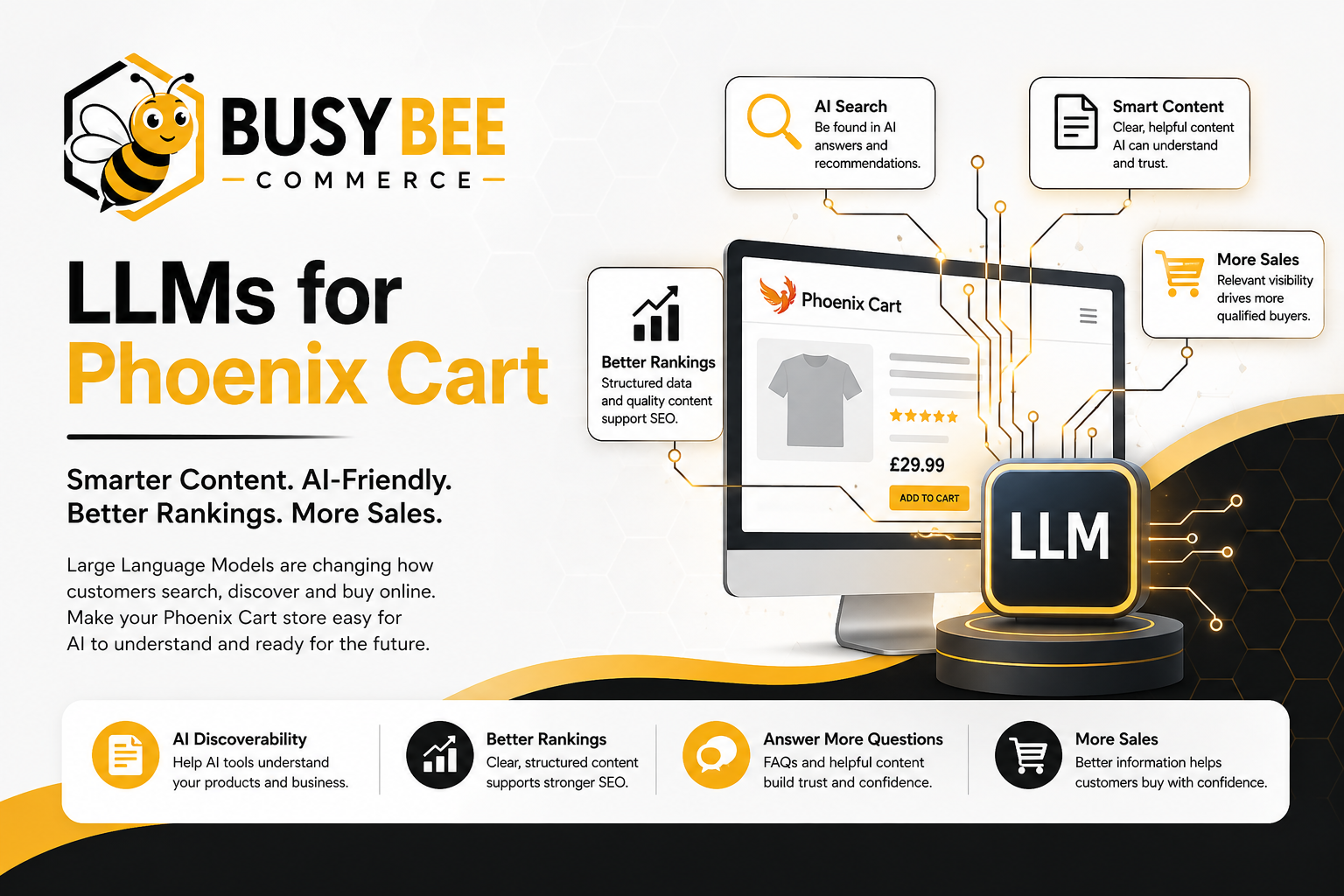
Phoenix Cart & AI Discovery
Why LLMs Matter to Your Phoenix Cart Store
Search is changing. Customers are increasingly using AI-powered assistants and large language models to research products, compare options, answer buying questions and discover businesses. Making your Phoenix Cart store clear, structured and easy for machines to understand can help prepare your ecommerce business for this new way of discovering information.
From Search Engines to Answer Engines
For years, ecommerce visibility has largely focused on traditional search engines. Store owners optimise product names, descriptions, page titles, URLs and internal links so that search engines can understand their products and present them to potential customers.
That remains important, but customers now have another way to find information.
Large language models — usually shortened to LLMs — can interpret questions written in everyday language and produce useful conversational answers. Instead of searching only for “handmade lavender soap UK”, somebody might ask an AI assistant:
“Can you recommend a handmade lavender soap that would make a nice gift?”
This creates a new challenge for ecommerce stores. Your website should not only be attractive to customers and understandable to search engines — its information should also be clear, accurate, structured and easy for AI systems to interpret.
What Exactly Is an LLM?
A Large Language Model is a type of artificial intelligence designed to understand and generate language. It can analyse questions, recognise relationships between concepts and produce answers in natural, conversational language.
For an ecommerce business, the important point is not how the underlying technology works. What matters is that people can increasingly ask detailed shopping questions instead of simply typing a few keywords into a search box.
That means the quality and clarity of the information published by your store becomes increasingly important.
How AI Changes Product Discovery
Traditional search and conversational AI can approach the same buying decision in very different ways.
Traditional Search
A customer might search for short phrases such as lavender soap gift, natural soap UK or Phoenix Cart addons.
Conversational Discovery
A customer can ask a much more detailed question explaining exactly what they need, who it is for, what features matter and what problem they want to solve.
This makes detailed product information particularly valuable. An AI system can only understand useful characteristics of your products when that information is available clearly and accurately.
Why This Matters to a Phoenix Cart Store
Preparing for AI discovery can also improve many parts of your existing ecommerce strategy.
AI Discoverability
Clear information makes it easier for automated systems to understand what your business sells and how individual products differ.
Better SEO
Many practices that improve machine understanding — descriptive content, good structure and clean URLs — are also valuable for traditional SEO.
Better Product Pages
Detailed information helps customers understand products and gives automated systems more useful context to interpret.
Better Answers
FAQs and clearly written information can answer the kinds of natural-language questions customers increasingly ask.
Clearer Store Structure
Categories, internal links and consistent terminology establish relationships between products and subjects across your store.
Fewer Ambiguities
Accurate specifications and clearly stated policies reduce uncertainty for customers, search engines and AI systems alike.
Phoenix Cart Opportunity: You do not need to rebuild your store around AI. Much of the groundwork involves improving information you should already be publishing — product details, categories, business information, policies, FAQs, structured data and useful supporting content.
1. Give Every Product a Clear Identity
An AI system should not have to guess what a product actually is.
Product names should clearly identify the item. Descriptions should explain what it does, who it is for, its important characteristics and anything that distinguishes it from similar products.
✕ Weak Product Information
Lavender Dream
Lovely soap with a wonderful fragrance. Great as a gift.
✓ Clearer Product Information
Handmade Lavender Soap Gift Bar
A handmade lavender soap bar with a relaxing floral fragrance, attractively presented for everyday use or gifting.
The second version provides far more context. A customer understands it more quickly, and an automated system has more information available when trying to match the product to a relevant request.
2. Answer the Questions Customers Actually Ask
Conversational search makes customer questions particularly important.
Think beyond the basic product description. What questions might somebody ask before buying?
Who Is It For?
Explain the intended customer, recipient, use case or environment where that information is relevant.
What Does It Do?
Explain the practical purpose and benefits rather than relying entirely on technical specifications.
Why Choose It?
Explain the characteristics that distinguish the product from alternatives.
Useful approach: review real questions from customers, emails, support requests, reviews and product enquiries. These can reveal information that is missing from your product pages.
3. Build Useful FAQs
FAQs naturally match the question-and-answer format used by conversational AI.
A useful FAQ should answer genuine questions rather than exist simply to contain extra keywords. Depending on the product, useful questions might cover:
Product Questions
- What is included?
- What size is the product?
- Which models is it compatible with?
- What material is it made from?
- Is installation required?
Buying Questions
- How quickly is it dispatched?
- Is it suitable as a gift?
- Can it be returned?
- Is support included?
- Are there related products?
Write Facts, Not Marketing Fog
Statements such as “amazing quality”, “fantastic product” and “the ultimate solution” provide very little concrete information.
Specific facts are much more useful. Explain dimensions, materials, compatibility, included features, intended use, delivery information and other characteristics that can be verified.
Clear factual content helps customers make decisions and gives machines more meaningful information to interpret.
4. Keep Important Information Consistent
Conflicting information makes your store harder to trust and harder to interpret.
If one page says a product includes free delivery while another says delivery is charged, or a product specification differs between a category page and product page, customers become confused.
Consistency should apply to product names, specifications, prices, availability, company information, policies and terminology throughout the store.
Good practice: maintain important product information from a reliable source within your store rather than manually reproducing changing information in multiple unrelated places.
5. Use a Logical Category Structure
Store structure helps establish context and relationships.
A product appearing inside a clearly named category gives additional context about what it is and how it relates to other products.
Categories should therefore be designed for customers rather than filled with awkward keyword variations. Clear names and sensible hierarchies make navigation easier while improving the overall information structure.
6. Strengthen Internal Linking
Internal links can show relationships between products, categories, guides and supporting information.
A guide about improving Phoenix Cart navigation might naturally link to a relevant navigation add-on. A gift guide might link to suitable products and categories. A product might link to compatible accessories.
The test is simple: would the link genuinely help a customer understand the subject or take a useful next step? If the answer is yes, it is probably a worthwhile internal link.
7. Make Your Business Easy to Understand
Product information is only one part of understanding an ecommerce store.
About Your Business
Clearly explain who you are, what you sell and what makes the business relevant to its market.
Contact Information
Make legitimate contact routes and customer-service information straightforward to locate.
Store Policies
Delivery, returns, privacy and other important policies should be clear and accessible.
8. Structured Data Still Matters
Machine-readable information can help systems understand the entities and facts represented by a page.
Ecommerce structured data can describe information such as products, offers, prices, availability, ratings, reviews, breadcrumbs and business details where appropriate.
Keep it truthful. Structured data should reflect genuine information visible or represented by the page. Never invent reviews, ratings, stock information or other data to make markup appear more impressive.
9. What About llms.txt?
You may increasingly encounter references to a proposed file called llms.txt.
The basic idea is to provide a concise, machine-friendly guide to useful information on a website, helping AI-oriented systems locate important resources without needing to infer the entire structure from navigation alone.
It can be thought of as a curated map pointing towards useful content about your business, products, documentation or other important resources.
A Simplified Ecommerce llms.txt Concept
A Phoenix Cart store could potentially provide a concise description of the business and links to particularly useful areas.
# Example Store
An online retailer specialising in handmade bath and body products.
## Important Pages
* About the Store
* Delivery Information
* Returns Information
* Contact Information
## Product Categories
* Handmade Soap
* Bath Products
* Gift Sets
## Helpful Guides
* Choosing a Handmade Soap
* Bath and Body Gift Guide
An online retailer specialising in handmade bath and body products.
## Important Pages
* About the Store
* Delivery Information
* Returns Information
* Contact Information
## Product Categories
* Handmade Soap
* Bath Products
* Gift Sets
## Helpful Guides
* Choosing a Handmade Soap
* Bath and Body Gift Guide
Important: llms.txt should be viewed as an emerging convention rather than a guaranteed route to inclusion in AI answers or product recommendations. Publishing one does not mean an LLM will automatically use, cite or recommend your store.
Phoenix Cart Opportunity: an llms.txt generator could potentially build a useful file automatically from store information, categories and selected content, reducing the need for store owners to maintain the file manually as the catalogue changes.
10. llms.txt Is Not a Replacement for SEO
Preparing for AI discovery should complement your existing optimisation rather than replace it.
Keep Doing SEO
Continue improving page titles, descriptions, URLs, internal links, content quality and technical SEO.
Keep Improving UX
Customers still need a fast, usable and trustworthy store once they arrive.
Add AI Readiness
Treat machine-readable content and AI discovery as another layer in your overall ecommerce strategy.
SEO, AEO and AI Discovery Can Work Together
You may see terms such as SEO (Search Engine Optimisation), AEO (Answer Engine Optimisation) and other names used to describe optimisation for AI-driven discovery.
The terminology is less important than the underlying principle: make your website technically accessible, clearly structured, factually useful and easy to understand.
Those qualities benefit search engines, AI systems and — most importantly — customers.
11. Create Content That Demonstrates Knowledge
Your product catalogue tells people what you sell. Supporting content can explain what you know.
Useful guides, tutorials, comparisons, buying advice and answers to common questions can build a much richer information environment around your products.
Buying Guides
Help customers understand which product is appropriate for different needs.
How-To Guides
Explain how products are installed, used, maintained or combined with other products.
Expert Answers
Answer detailed questions customers regularly ask about your products or specialist area.
12. AI Can Also Help You Improve the Store
LLMs are not only a new discovery channel. They can also be useful tools for store owners.
Content Ideas
Generate ideas for FAQs, buying guides, category content and subjects customers may want explained.
Content Analysis
Identify missing information, unclear wording, repetitive descriptions and opportunities to improve page structure.
Customer Support
AI-assisted tools can help organise support information and potentially answer routine questions when carefully implemented.
Product Data
LLMs can help turn rough supplier information into structured drafts that a store owner can review and improve.
SEO Assistance
They can help brainstorm titles, meta descriptions, FAQs and alternative ways customers might describe products.
Quality Checking
AI can help identify inconsistencies, but important product facts should always be verified against reliable information.
Never publish blindly generated content. LLMs can produce incorrect information with complete confidence. Product specifications, prices, compatibility, legal information, policies and other factual claims should always be checked before publication.
13. Avoid Filling Your Store With Generic AI Content
Having access to fast content generation does not mean more content is automatically better.
Hundreds of generic pages that simply repeat information already available elsewhere may add little value. Your strongest content comes from combining useful technology with genuine knowledge of your products, customers and business.
✕ Generate & Publish
Ask AI for a product description and immediately publish whatever it produces without checking facts, usefulness or whether it sounds like your business.
✓ Generate, Review & Improve
Use AI to help create a draft, then add genuine product knowledge, verify every important fact, improve the wording and make the finished page useful to your customer.
14. Prepare Your Phoenix Cart Store for AI Discovery
AI readiness does not need to be a complicated one-off project.
1
Improve Product Data
Make product names, descriptions, specifications and images accurate and descriptive.
2
Improve Structure
Review categories, URLs, internal links, business information and supporting content.
3
Add Machine Context
Review structured data and consider emerging mechanisms such as llms.txt where useful.
4
Keep Improving
Update information as products, customer questions and discovery technology evolve.
Think Like the Customer Asking an AI Assistant
One of the easiest ways to identify missing content is to imagine the questions somebody might ask before choosing your product.
Example: Phoenix Cart Add-on
Customer question: “Is there an add-on that lets me control which categories appear in my Phoenix Cart navigation?”
A useful product page should clearly explain whether the add-on does this, what other navigation controls it provides, which version of Phoenix Cart it supports, how it is installed and whether technical knowledge is required.
Example: Gift Product
Customer question: “I need a small handmade lavender gift that can be posted directly to somebody.”
Useful product information might include dimensions, presentation, fragrance, gift suitability, packaging, dispatch information and whether a gift message can be included.
Phoenix Cart AI & LLM Readiness Checklist
Use clear, descriptive product names.
Write original product descriptions.
Include useful product specifications.
Explain benefits and intended uses.
Answer genuine customer questions.
Add useful product FAQs.
Keep product information consistent.
Use logical categories.
Create useful internal links.
Maintain clear business information.
Publish accessible store policies.
Review structured product data.
Use clean canonical URLs.
Maintain strong traditional SEO.
Create genuinely useful guides.
Consider whether llms.txt is useful.
Review AI-generated content manually.
Verify every important factual claim.
The Stores That Benefit Most Will Be the Stores With the Best Information
Nobody can guarantee that a particular AI assistant will recommend a particular ecommerce store. AI discovery technologies, crawling practices and commercial shopping experiences will continue to evolve.
But one principle is unlikely to become obsolete: clear, accurate, useful and well-structured information is easier for both people and machines to understand.
Improving those qualities is therefore not a bet on one particular AI platform. It is an investment in the quality of your ecommerce store itself.
Make Your Phoenix Cart Store Ready for the Next Generation of Search
Traditional SEO remains important, but product discovery is becoming increasingly conversational. Build clear product pages, publish genuinely useful information, strengthen your store structure and make important facts easy to understand. By doing so, your Phoenix Cart store will be better prepared for search engines, AI-powered discovery and — most importantly — the customers those technologies send your way.
Let Us Help Your Store Reach It's Potential
Need expert Phoenix Cart development services?
Get in touch today.
Comments
0
No comments have been published yet.